
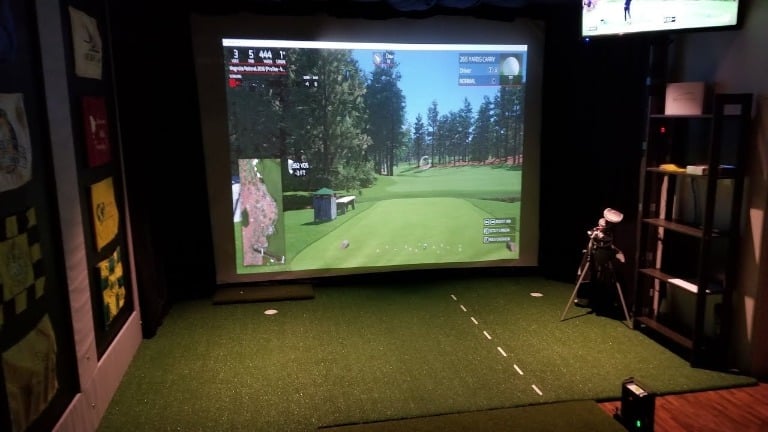
A projector is there to simply make your work easier by projecting a figure or picture or even words as desired by you. Using a projector is not only a modern way of doing things but it speeds up communication by expanding the image of words or figures being communicated. Meanwhile, it is not every time that you can make it to play golf outdoor with your mates. Nonetheless do not be sad at times when that is not possible all you need is an excellent projector and a good golf simulator to get you started and you can play golf in the comfort of your home.
Get a projector today and improve your shot with ease. But wait finding the best projector for your golf stimulator can be burdensome if you have no knowledge of where to get a suitable projector. Fortunately, it will no longer be a burden or challenge but a walkover as I will run you through the best projectors for golf simulators on the market. And once this tour is done the only challenge you may have will be on which one to pick as all the projectors being reviewed are among the best there is on the market.
With so many projectors on the market as I earlier alluded, I now at this point bring out the best projectors there is just for you. I am reviewing over eight products and this will give you enough room to choose from a variety that I endeavour to present before you.
Top 8 Best Golf Simulator Projectors
- Optoma GT1080Darbee short throw projector
- BenQ HT2150ST
- Optoma EH200ST
- LG HF85JA
- ViewSonic PJD5353LS
- BenQMW632ST
- Optoma EH 200 ST
- Optoma HD27
Oops! And now! now and now we break down each one of the above projectors to equip you with the right knowledge. Let’s do this I bet you are very excited to see what these projectors are made of.
1.Optoma GT1080Darbee Short Throw Projector

This projector is one of a kind it is big and has brilliant features. Its energy efficiency is just very amazing and it is complete and I mean full 3D engineered just for you. It is very affordable and provides an enhanced gaming mode in the best of the high-class rapid response of time, thereby keeping you in the game way ahead than your competitors. That is not all it has amazing saving features that bring about high performance with 8000 hours of life with the lamp life. Moreover, it enhances images for extraordinary levels of depth, detail, and lighting to mention but a few. It produces extremely detailed and sharp images.
Features:
It has a Darbee image processor, the GT1080 Darbee vision image enhancement technology has the ability to enable greater detail in textures and reflective surfaces providing an unsurpassed gaming experience. it has short throw lens experience a large 120’’ image projected from 4 feet away; short projector throw which allows placement closer to your screen which also makes it ideal for smaller spaces and easier installation. It has enhanced gaming mode which makes you enjoy lighting fast response times of 16 Ms. The projector is versatile it is suitable for a variety of environments like family rooms, theater rooms and even outdoor spaces like backyards, camping, and tailgating to mention but a few. Mind-blowing picture quality razor-sharp images with 3,000 lumens, 28,000 1 contrast ratio, Full Hd 1080 p which is about 1920×1080. It has a full 3D display content from almost any 3D source that includes 3D blu ray disc players, 3d broadcasting and the latest generation game consoles. it has flexible connectivity and the image is easy to set up and finally, it is a long lamp life with up to 8,000 hours of lamp life that enables an average of 4 hours of viewing time every day for 10 years plus.
Specification:
Native resolution 1080p 1920×1080, it has MHL and REC 709, contrast ratio is 28000:1, USB power ,2×10 watt speakers, wireless presentation HDCastpro and a screening mirror .it has 1,07 billion displayable colors.
2. BenQ HT2150ST

 This projector has amazing features that cause it to stand out in the midst of others. It has cinematic color technology that utilizes optimal color to bring out the most enhanced and accurate images to you. And knowing that only true colors convey deep feelings, this projector knows just how to do that with so much ease. Colors evoke feelings and help you and me to relate with things presented before us and this projector provides about 7.09 HDTV standard color coverage thereby ensuring perfect color consistency. And just to boast a little and boost your bubble. Rec.709 is an international HDTV standard that is able to depict the colors the director intended without compromise. so yes this is me telling you that BenQ HT2150ST produces accurate and authentic colors of Hollywood films. Now imagine you making that shot with this kind of quality.
Furthermore, with this projector, you are able to enjoy the 100’’ screen. and it allows short-throw technology to be positioned in small spaces with stress-free and quick installation. And guess what this is too good to be true but t s true, it gives you a 2XHDMI that is able to make connectivity to your HD and streaming content.
And now we unfold it’s not soo complicated features they are actually quite many but hey that is what makes this package what it is.
Features:
It has unparalleled picture quality, Superior short-throw projection that enables you to project a 100-inch screen from just 3 feet letting you fully immerse into your games. Project up to 300 inches. It has high responsiveness, the specialized low input lag, and unique game modes ensure gamers an ultra-smooth and comprehensive gaming experience. Amazing warranty, 3-year limited parts, and labor coverage make you rest easy that our US-based customer service team is here when you need it.
I am hiding nothing from you so now I present to you the positives and negatives of this awesome projector.
Specifications:
Its display Projection System: DLPNative Resolution: 1080p (1920 x 1080) Resolution Support: VGA (640 x 480) to WUXGA_RB (1920 x 1200), Blanking Brightness (lumens): 2200, Lumens Contrast Ratio (FOFO): 15000: 1, Aspect Ratio: 16: 9, Light Source Life: 3500 / 5000 / 7000 hours, PicturePicture Mode: Bright/Vivid/Cinema/Game/Game(Bright), 1080pVideo Compatibility: NTSC, PAL, SECAM, SDTV(480i/576i), EDTV (480p/576p, HDTV (720p, 1080i/p 60Hz)3D, and Weight Dimensions (W x H x D)(mm): 380. 5 x 121. 7 x 277 mm Net Weight (lbs.): 7. 27lbs.
I am hiding nothing from you so now I present to you the positives and negatives of this awesome projector.
3. Optoma EH200ST

 This has a very high contrast ratio that ensures that you see and enjoy clears and crispy images. The above is even the number reason as to why you should purchase this. Additionally, it is an all-digital short throw projector. It has brilliant color technology and uses the Texas instrument brilliant color technology. It uses exceptional contrast ratios for pin-sharp graphics and crystal clear images. And this projector has a full 3D compatibility and it has the ability to display true 3D content from almost any 3D source in this case including 3D Blu-ray players and the latest generation games consoles to mention but a few.
It is beautiful and has a very lively color by design. Green is its color. This is because it has been created for eco-friendliness to use 0.5-watt power consumption in standby mode up to 75 percent savings compared to regular standby mode.
Features:
It can project a 100 ‘’ diagonal image at only 3.5 –feet from the screen. It has all-digital connectivity for the lowest latency and faster response time almost every time. It has MHL enabled HDMI port, present directly from your phone or even tablet. VESA 3D sync port, computer compatibility: UXGA, SXGA, WXGA, HD, XGA, SVGA, VGA. Mac light Source type is 190 W and a throw ratio of 0.49.
Specifications:
Backlit IR remote control, input/output connectivity,1080 p high resolution with bright and vibrant visuals that produce pin-sharp graphics and crystal clear text. It has an in-built speaker with two HDMI, whisper-quiet operation.
4. LG HF85JA

 It is very good. This one has been naturally designed to produce large and huge images from a small package and it can project with ease images up to 100’’ in size. It additionally has an impressive resolution which means that images will always be clear. that is not all it has a ratio of 150,000:1 which implies that this projector is able to show beautiful detail in all images. It has smooth image quality and over 81percent brightness uniformity which is very exceptional. It has a very pleasing and sufficient contrast for dark room viewing. It has over four picture modes available, even though image changes are subtle between most modes, the cinema mode definitely gives the image a very pleasurable theater-like experience.
Its fan noise is very low in normal mode and is made of low and medium frequencies that are not distracting at all. And despite it being low in normal mode, Eco mode lowers it to a whisper with a 25 percent reduction in brightness. It has very few features but oh boy it’s a trophy.
Features:
1500 lumens, contrast is 150,000:1, the resolution is 1920×1080, the native aspect ratio is 16:9 HD, color processing 8-bit .it has a display type of DLP 1. audible noise is 30.0Db/26.0Db with a digital keystone of horizontal and vertical.
Specifications:
Projector size 7.50’’x5.50’’x13.90’’, weight is 6.6 lbs. Video modes 720p,1080i ,1080p/60,480p, data modes are MAX 1920×1080, lamp life is 20,000 hours, lamp type is laser phosphor, has a fixed focal length and std. lens focus. Speakers are 3.0Wx2, max power is 140 watts, voltage is 100 V -240 V.
5. ViewSonic PJD5353LS

 It has a very user-friendly design and a sleek white chassis. It additionally has a super color technology that gives a wider color range for true –life projection. It also has a cable management hood that connects onto the back of the projector that hides unsightly cable clutter and exported ports. Another beautiful aspect of his projector is that it has an easy access top lamp door that helps and enables simple lamp maintenance and replacement.
It has like five extraordinary viewpoints that provide the best possible viewing experience in any environment you may be in irrespective of available ambient light. Not only that it is equipped with the most recent HDMI. It is perfect for connecting to any HDMI enabled device because it can display 3D images directly from 3D Blu-ray players.
It finally has a 3 year limited parts and 1-year lamp and the first year free express exchange service. What an amazing product warrant.
Features:
Versatile projector and is advanced in visual features, big screen projection that is able to project 120 inches from 8-feet 2 inches in 3200 lumens. It is easy to set up, long life lamp with a dynamic eco-mode that allows the lamp to shine brighter for up to 10,000 hours. it also has flexible connectivity.
Specifications:
3200 lumens, XGA 1024×768 native resolution, sonic expert technology, smart design, AC in, VGA x2, control panel, monitor out, RS232, USB type mini B, Kensington lock slot, focus ring, projection lens, elevation foot, HDMI. it has a video in, audio in/out and an IR remote sensor.
6. BenQMW632ST

 It has a vertical keystone function that allows abundant alignment ensuring that there is a lovely experience with your golf stimulators. Not only that it is very affordable and has the ability to throw clear images from short distances and a very high contrast ratio that ensures that dark blacks and bright whites. And it is very easy to install and quite impressive and it has an executive quality designed just for you.
This is very suitable for your golf simulations and can be used for may applications. And it provides a well-turned picture where you can even imagine that you are on the green itself. It has a short throw with no obstruction at all. It can create large images from even short distances. It’s a very carefree setup and I strongly encourage you to purchase this.
Features:
WXGA resolution which is 1280×800, suitable for any environment, extended lamp life, ability to show big picture in small spaces and has standard connectivity of 2 HDMI ports that provide good audio and video quality in just one cable, integrated 1.5A USB type – A power output.
Specifications:
Built-in 10 W speakers, 13,000:1 high contrast ratio, display color 30 bits,24 keystone adjustment, lamp light source wattage-196light source life, MHL connectivity.
And lastly, among its diverse features, it has a full HD 3D for your immersive viewing experience.
7. Optoma EH 200 ST
Yet another glamourous baby on the market made just for you. It is a beautiful short throw and it’s well packaged and comes with the following items as those listed below:
- EH 200ST projector
- Carrying case
- Lens cap
- Ac power cord
- Remote control
- Batteries for remote
- multilingual CD-ROM user’s manual
- Quick start card and a warranty card
It can produce large screen sizes from a very short distance, meaning you can get a 100-inch image by placing the projector at 3.5 feet from a wall or screen. And you can simply turn it into a smart display by connecting your smartphone or tablet with just an MHL cable.
It also has a full HD 1080 p that gives you a detailed and sharp and clear image from any kind of HD content without downscaling or compression of some sort. And it is green by design and complies with RoHS standards that help to phase out the use of hazardous materials.
Specifications:
It has an Optima EH200ST that brings all-digital short throw high-definition projection to conference rooms, training rooms, and classrooms. With the 1080p resolution 5.1 short-throw projection this projector brings out extremely brighter clear graphics, videos and presentations just a mention a few Whether your application calls for wall mounted installation or desktop projection, the Optima EH200ST will captivate your audience with its 3000 lumens bright image, vibrant, true-to-life colors and 20, 000: 1 contrast ratio. Equipped with two HDMI ports, MHL connectivity, VESA 3D sync port, 12V output supply, plus a powerful 10-watt speaker, whisper-quiet mode and more.
Features:
Distance from the screen is 3.5-feet and results in 100″ diagonal image, 20,000:1 contrast ratio, VESA 3D sync port. Light Source Type:190W and finally has a Throw ratio: 0.49:1.
8. Optoma HD27

 It is glam and very easy to install. It is not only the best for golf simulators but also for movies with its great picture quality. It has the ability to turn your home theater into a very big screen like that of a cinema. It has very vibrant colors that leave you speechless. It has a very portable size and awesome long lamp life and it completes that vibe in your home with its 10W speaker. The HD27 is one of the best projectors for gamers who like playing all their games on a big screen, it has video compatibility of both 1080i and 720p, with these good video resolutions you will surely enjoy the bright and crystal clear image. Also, this projector is great for viewing HDTV programs, new Blu-ray movies, and all major sports leagues.
It is able to produce clear and highly detailed visuals thereby making your experience very memorable. with its beautiful connectivity aspect, you certainly need this.
Read also: Best Laptops for Stock Trading
Features:
Throw ratio 3 1.48 – 1.62:1 its Brightness: 3200 ANSI Lumens. Contrast Ratio is 25,000:1; with Keystone Correction, Warranty: 1-Year Limited Parts and Labor, 90-Days on Lamp. Lightweight and portable.
Specifications:
This Optoma HD27 is an advanced 1080p Home Theater Projector sporting 3200 lumens, 1920×1080 Full HD Resolution, 1.1x Zoom, sRGB support, and 25000:1 contrast ratio. Input Lag (MS)- 33. Operating Conditions – 5 degrees Celsius – 40 degrees Celsius, Max. Humidity 85 percent, Max. Altitude 3000 meters.
Factors To Consider When Buying The Best Projectors for Golf Simulators
And finally, we have what is known as a five-way path. This is a route where I run you through summarized factors of what to consider when getting yourself a projector for your golf simulator. And they are very important because they will save you a whole lot of trouble.
And the factors are as follows:
Resolution
This is the number or amount of pixels that the projector uses to create an image. For instance, if one uses more pixels, the resolution will be higher and if one uses fewer pixels then the resolution will not be high. Now knowing this is important because it can show more complex picture detail compared to low-resolution projectors.
Brightness
Picture brightness is very important and adds to the overall outcome of whether the projector is effective or not. Both the projector’s light output and the screen’s gain determine how bright the entire picture looks.
Throw distance
The throw distance is the distance from the tip of the lens of the projector to the screen and this is very essential because it determines where the projector sits. Therefore, it is important that one positions it very well.
Aspect ratio
The aspect ratio is the ratio between a projector’s width and its height. It is very vital because it clearly gives you the feeling of how square or rectangular an image may be.
Lumens
This is simply the amount of light that is projected by a source of light. They are a need because the more lumens one produces the brighter and clearer the image will be. The unique display an image on a screen.
Furthermore, these projectors are not without benefits. They have outstanding advantages and a bit of a disadvantage but it’s amazing to see the advantages outweigh the disadvantages.
Advantages
- They allow you to play golf even when the weather is unfavourable.
- They can easily entertain your family and friends in the comfort of your home
- They help you to save a lot of time, they do not require you spending a lot of time
- They have the ability to give you feedback about your moves
Disadvantages
- They do not offer a real golf experience and satisfaction is not at its maximum
How To Maintain a Golf Simulator Projector
- Always check the lamp life
- Make sure it is very neat and clean every time
- Take your time when shutting it down, do not be too quick to do so as it may incur a problem
- And always acquaint yourself with what is written in the manual