

If you are looking for the best laptops for overwatch on the market today, then it is important that you focus on being able to look at the right things. Too many consumers tend to overlook certain features that can be important later on in the future.
But there are also enough laptops for gamers on a budget available in the market. Although they are made by compromising many features, they provide good gaming experience and are worth the money.
Though it can seem to be very easy to find a laptop, it can be tough to find the best budget laptops out there. With so many different features, it can be tough to find a few features to really focus on. Here are 3 things that you must look at before you spend your hard-earned money.
Top 5 Best Overwatch Laptops to Buy in 2020
1. ASUS UX303LA-DS52T

Welcome one of the thinnest laptops ever made! This laptop starts a new era of ultrabooks. By Intel’s definition, such thin and powerful laptops should be marked as an ultrabook. It is hard to believe that this laptop equipped with the newest 2.20 GHz dual-core Intel Core i5-5200U, 8 GB DDR3L RAM, 256 GB SSD memory and 6-cell battery weighs only 2.43 lbs! With its display size of 13.3-Inch Multi-Touch screen and thickness of only .12 inches, it has all you might need including 3xUSB 3.0 port, 1x mini VGA port, 1x micro HDMI port, stereo speakers powered by Bang&Olufsen ICEpower, a 0.3-megapixel camera and other.
We were very pleased by it’s brushed aluminium alloy body, which keeps your laptop in safe from physical shock and also gives your laptop significant look. It is unbelievable to have such an incredible processor in this size laptop. There are only two laptops has this laptop so far: Asus ZENBOOK and the latest MacBook Air. It is important to mention that Asus was named as #1 most reliable PC brand by 3 independent sources. This laptop goes with 1 year accidental damage protection, which means no matter how your laptop was damaged, Asus will fix it or replace it for you during the first year after purchase. Also, we like really the large size touchpad that this laptop has.
This laptop is one of the smallest and yet, high-performing laptops. It is made to be a good, reliable and small assistant with long battery life. It has good graphics powered by an Intel HD Graphics 5500 with shared graphics memory, but for anything else – it is just perfect
2. VAIO VJS132X0311S S

Have you heard about one of the newly arrived Sony VAIO S? Well, here it is. This laptop is fully equipped with new technology. An outstanding design, which goes hand in hand with it, makes it one of those things you want to own from the very first sight. But let’s talk about stuff which contributes to this deep impression. First of all the heart of this laptop is an Intel 8th Generation Intel Sandy Bridge Intel Core i7-8550U processor with 3.40GHz frequency, this is a top Intel’s processor supporting Turbo Boost Technology which enables you to rise the processor frequency up to 3.40GHz in case of necessity. Multitasking is not even a question for this processor. The graphics are no less important here too, and Intel UHD Graphics 620 with 1 GB of memory does very well. It is capable of working with all games at the highest quality settings without the slightest hesitation. It is also perfect for watching HD movies.
There should be a special chapter about its sound system, but I will only say that it is one of the best I’ve ever listened to.
Don’t forget about the whole other bunch of stuff inside: card readers, Wi-Fi, optical drive, web camera, multi-gesture and others that had become integral parts of top laptops.
This is the laptop most of the people are dreaming of. Without a doubt, it is a real Macbook Pro’s rival. It is difficult to judge which one is better, but I must say that you will never regret your choice.
3. Asus ROG Strix 15.6 Inch FHD Gaming Laptop

 It is extremely important to keep up with all the things going on around us. This portable but nevertheless powerful laptop will never let you fall behind. No matter where you are, the Asus ROG Strix is medium-sized and light enough to be carried with one hand, browse the Internet, read, playing games or work with others. All that being mentioned it is still comfortable (women have no trouble using it either).
How about its efficiency? Considering the fact that the laptop carries the 9th Gen Intel Hexa-core i5-9300H up to 4.1GHz, it is powerful enough to work with a couple of programs simultaneously effortless. This gaming machine is equipped with 16GB RAM of DDR4 SDRAM (1066MHz) and in case you are not satisfied with it, there is a possibility to increase it to 32 GB (processor supports up to 32GB depending on the type of memory). Let’s get to the graphics part, shall we? To be honest about its graphics, I wouldn’t say that it is this laptop’s strong side. The NVIDIA GeForce GTX 1660Ti is enough for playing any game, work and will allow you to spend some time watching HD movies.
The only thing we liked is it having a good graphics card that will allow you to play high graphic demanding games such as CSGO, Minecraft and Overwatch. Even though they say that gaming drains the battery fast, but we have received up to 10 hours of battery life instead
This light laptop will be an ideal choice if you are looking for every day portable working device. Upgrade it for extra productivity, and you’ll get more power for a reasonable price. I would consider it a gaming laptop light gamers.
4. ASUS ZenBook Flip

 Meet the newly renewed UX433FA-DH74. If you’ve encountered its previous revision then you’ll be able to spot the difference from the first glance, if not, well, that’s why we are here for. The notebook received Intel’s Sandy Bridge 8th generation Intel Core i7-8565u Quad-Core Processor (8M Cache, up to 4.6 GHz). Putting such a processor into this laptop was a wise decision as far as it has not only high productivity rates but also low energy consumption. No multitasking problems should appear thanks to 16GB LPDDR3 RAM (maximum supports 32 GB). This laptop has the best video card among laptops of this size and price range, which is Intel UHD Graphics 620 with 2 GB of Video-RAM, which supports DirectX-11. Actually there is no other compact laptop under $1000 which has such good graphics. Also, for those who need storing many files on their laptops, this laptop has 512 GB HDD.
An extra bonus is that this laptop is very light and compact, with its 14-inch screen and a weight of 2.6 pounds.
Good and powerful laptop! It is a good choice for everyone who needs mobility: businessman, gamer and average user, everybody will be satisfied with its unbelievable performance. Also, this small 2.6-pound laptop has a nice 3-cell battery to make it the best choice for travellers and people who need their laptops everywhere at any time.
5. TOSHIBA Tecra HD Business Flagship

 When you are looking for something, you always try to find something special, something that no one else has. When you get acquainted with the TOSHIBA Tecra 15.6 inch HD Business Flagship High-Performance Laptop, the first thing which really surprises isn’t its productivity, which is very good, but the price. Imagine a laptop with an 8th Generation Intel Core i7-8550U Quad-Core Processor (8MB Cache, 1.8GHz Up To 4.0 GHz) perfect for almost any type of work or game, plus 16GB of DDR4 (with the possibility to upgrade to 32 GB). This ensures its high multitasking performance. Moreover: Intel UHD Graphics 620 which has 64 MB – 3200 MB of dynamically allocated shared memory, more than enough to enjoy modern games played with maximum settings.
There is a very vague chance that you might find something better for the same price. This brilliant laptop combines both efficiency and reliability and all for the ridiculous price. This gadget would be an ideal birthday present or family purchase.
Things you should keep in mind while choosing the Best Overwatch Laptop
Today you can find a wide range of laptops on the market. Many of them might look very similar, but as a general rule – there are no similar laptops. So, for people who don’t keep an eye out for the newest technological developments or don’t know a lot about computers, the process of choosing the best laptop could become extremely frustrating quickly. Some people go to local stores and ask a salesman what he or she would recommend. The others try to search for technical information to figure out what the real differences are between the newest laptops. Yet, others search for the most popular laptops.
To tell you the truth, in most cases you can not find a good laptop for your needs in a local store because they usually don’t pull out the new stock until the previous has been sold. I respect people who try to figure out the real differences between laptops, but I know that there is a lot of misleading information that you can find on the internet. Obviously companies who develop new laptops or hardware try to convince you that every model they design is much better than the previous one. I can make a huge list of technical products where the older model was better than the newer one. It’s really sad to see just how many people believe advertisers and buy the laptops which they endorse, but which also seems to cost an arm and a leg when in reality these laptops are of average quality. Most popular laptops are really only a marketing scheme.
It will be very hard for me to cover every aspect of choosing the best laptop/computer, but I will try to cover the most important information. If you need further details on anything mentioned here – leave a comment and I will get back to you with an answer to your question.
Processor
Today you can see a large number of different processors, but what makes the real difference? Let’s take a look.
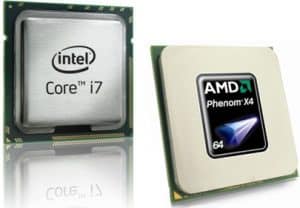
The number of cores.
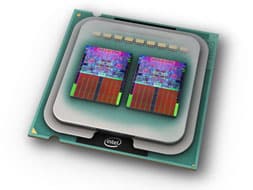 Today you can find processors with up to 6 cores, and soon AMD will announce it’s new AMD Bulldozer, which has 12 cores. Are cores really that important? When the question is about one or two cores, in most cases, my vote would be for two cores. If the question is two, three or four, it depends on the clock speed of each core. Today we have nice processors with 4 cores that have a clock speed of 2.2 GHz, but it’s also very common to see laptops with quad-core processors with a clock speed of 1.7 GHz, which I don’t recommend at all. Even dual-core processors, which in today’s world, usually have a frequency of 2.66 GHz, are better than these quad-core processors. Having more cores doesn’t mean all of them will work simultaneously while you are running an application. In most cases, only the first core is loaded with processes, because the major part of all applications doesn’t support multithreading, so they cannot be processed by different cores. However, there are many applications that can work with two cores, that’s why two cores might come in very handy today. Some applications support quad-core processors and I believe there will be many more of them within the next few years. But as a matter of fact, most applications can not utilize all of the power of modern processors, which is why you don’t really need many cores as of yet.
One more very important fact about the number of cores:
You can find many laptops with Intel Pentium Dual-Core processors, which are not really dual-core. These processors have two cores but only one bus to transfer data. So, this processor can not perform as well as an actual dual-core processor because if you load your laptop with a large number of applications, the bus will be loaded with data and both cores will not be able to perform as those in a normal dual-core processor. Therefore, this processor should be considered as a good single-core.
Cache
Processors operate with data, which they acquire from RAM. Loading data from RAM takes a lot of time, so processor designers have decided to create processors with a small separate space, where data is stored until it is processed. That was a brilliant idea! By doing this, they have made computers work at least 3 times faster.
Today you can find processors with an L1, L2, and L3 cache. The larger the capacity of your processor’s cache is – the more data it can store for processing without having to load it from your RAM. Usually, it doesn’t make a difference until you run some very powerful applications or load your computer with a large number of applications running simultaneously. When you load your processor with a large amount of data, it makes a really big difference. So, if you know you are going to do that, I highly recommend having a large amount of cache memory as possible. For laptops – try to search for laptops that have processors with a 3MB L3 Cache or higher. For desktop computers – 6MB is the minimum you should aim for today.
Clock Rate
The clock rate of your CPU(Central Processing Unit) shows how many operations per second it can process. So, the higher the clock rate of your processor, the faster it will work. Clock rates are measured in megahertz (MHz) or gigahertz (GHz). In modern processors clock rate usually varies from 2.6 to 3.8 GHz for desktop processors and from 1.1 to 2.8 GHz for laptops.
RAM
RAM (Random Access Memory) is a memory which stores data related to the applications that you are running.
Desktop computers use DIMM (dual in-line memory module) memory while laptops use SODIMM (small outline dual in-line memory module). The main difference is in their size. Here are the main characteristics of RAM:
Amount of memory
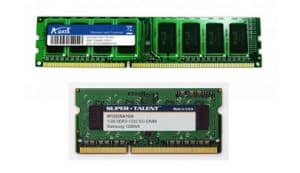 We have already figured out that retrieving data from RAM takes more time than retrieving it from a processor’s cache memory. But when RAM gets loaded with memory, it starts storing it on one of the data storage devices: either the HDD (Hard Disk Drive) or the SSD (Solid State Drive). If a processor has to receive data from the HDD or SSD, your computer will slow down dramatically. Thus, I recommend avoiding laptops with less than 4 GB of RAM. However, for smaller laptops, 2 GB might be enough if you install Windows XP or Linux on it. The 6 GB of RAM will be much more than enough for the average user, but if you are an extreme gamer and you play the newest games on your laptop you might need 6 or even 8 GB of RAM.
If you ask me – 4 GB is an optimum amount of RAM memory for 90% of today’s users, but people who use their laptops for some very complicated tasks, like designing, audio recording, movie-making or extreme gaming, need 6 GB or more.
DDR2 VS DDR3
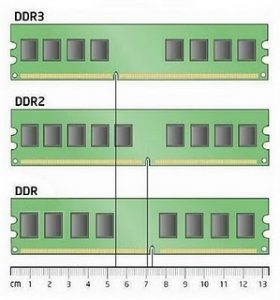 You can find laptops with DDR2 and DDR3 RAM memory. DDR (Double Data Rate) transfers the data two times faster than the Single Data Rate (SDRAM). DDR2 supersedes DDR and DDR3 supersedes DDR2. Neither of them is compatible. The DDR, DDR2 and DDR3 work with different clock speeds and the DDR2 works two times faster than the DDR and the DDR3 works three times faster than the DDR. Obviously, DDR3 RAM is much faster than DDR2, that’s why we highly recommend that you avoid laptops with DDR2 memory.
Clock rate
As long as we are not talking about the DDR2 memory, the optimum clock rate for RAM memory is 1333 MHz, but 1066 MHz is still good. Tests have proven that 1600 MHz doesn’t make a noticeable difference in comparison to 1333 MHz.
Graphics
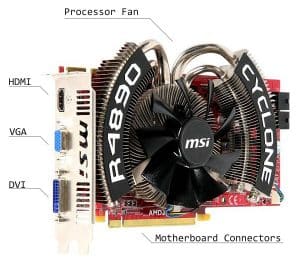 Integrated VS dedicated. Integrated graphics processor (Integrated graphics solution or shared graphics solution) is a part of the main processing unit which manipulates graphics tasks. Dedicated graphics cards have their own RAM and Graphics processor which offloads the main processor and also can perform much better than integrated graphics solutions. Last year every company that produces laptops unveiled laptops with dedicated graphics that perform much better than ones with integrated graphics. Soon, almost every laptop will include dedicated graphics. Integrated graphics have a nice advantage – they conserve your battery life, so integrated graphics solutions are acceptable for small ultra-portable laptops and netbooks. Both of them are primarily used while commuting or traveling, that’s why battery life may be crucial. Another advantage is that laptops with integrated graphics solutions are much cheaper, so if you want to save some money, I recommend looking for laptops with integrated graphics solutions. If you are looking for a high-performing laptop, I highly recommend sticking with dedicated graphics cards as long as they will take care of all your graphics processing tasks at an optimal level. It will also save the Central Processing Unit from being overloaded with graphics processes, which in turn, will increase the general performance of your laptop.
In today’s world, we have amazing technology called NVidia Optimus. It switches graphics to the dedicated card when you need the highest graphics performance and it also conserves your battery life by switching to integrated graphics solution when you are not performing complicated graphics tasks.
DDR3 VS DDR5.
We already know what DDR is, so, obviously, it looks like DDR5 is way better than DDR3. This is in the case that you are an extreme gamer who needs the fastest response in order to have the advantage over your opponent. Usually, you won’t see a difference between DDR3 and DDR5 Video RAM on your laptop, except in the price. DDR3 graphics are much cheaper than DDR5. Unless you are a gamer, you edit videos or work with 3D graphics, you don’t need DDR5 because DDR3 graphics will absolutely be enough.
Amount of video memory
If you need your laptop for gaming, I recommend looking for a 1 GB graphic’s memory or greater, especially if you like racing. If you prefer shooter games and you want to save some money – 512 Mb will be enough for almost any shooter game and some other games as well, but the newest games will require more memory and may slow down from time to time. If you are working with graphics, video or 3D modeling, anything between 512 Mb and 1 GB should be enough for you. People who use their laptops only for business, office-work or basic every-day computing don’t need a large amount of video memory. So, anything over 128 MB will be fine, but usually, the bare minimum for video memory is 512 MB, so you shouldn’t worry about video memory. Actually, even integrated graphics works fine when we are talking only about office-work, internet browsing, and other tasks, which don’t include any 3D-objects.
64 VS 128 bit.
This parameter shows the number of bits that can be transferred during one period of time. It actually shows how wide the data bus is. Most compact laptops include only 64-bit graphics, but if you are not looking for an ultra-portable laptop, I recommend searching for laptops with 128-bit graphics.
Memory Storage
 You will need to look at the computer specs and make sure that there is enough memory to be able to hold all of the files that you will be storing in it. Too many consumers forget to look at specs and will totally overlook how important it is. After they fill their computer up with pictures and videos, they then complain about how slow the computer has gotten.
This is certainly something that you should look at before you go out and buy a laptop. The best budget laptops will have enough memory for you to keep a good amount of pictures and videos so you should not worry too much.
There are two main memory storage devices: HDD and SSD. Let’s take a closer look at them:
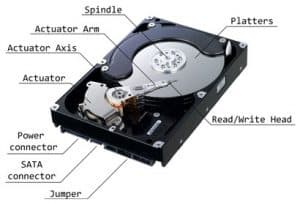
HDD (Hard Disk Drive) is the most common device for data storage. It consists of platters (or simply disks), a read/write head and actuator. There are two main connection ports you can find in HDD: IDE (Integrated Drive Electronics) and SATA (Serial Advanced Technology Attachment). IDE ports are very rare and can only be found on computers assembled before 2005. The good thing about HDD is that it can store a large amount of data and storage of 1 GB is rather cheap. Different HDDs have different capacities (the amount of GB it can store) and speeds of disk rotation (rpm or revolutions per minute). You are the one that has to decide how much space you need, but usually, 320-512 GB is enough. People who store a lot of music and video files might need 750GB or more.
Most HDDs have a speed of 5400 or 7200 rpm. While 5400 is sufficient, I recommend choosing one with 7200 rpm when possible, because higher rpm translates into faster data access.
You have to remember that an HDD can be easily damaged by physical shock because a read/write head can scratch the platter just by touching it. Considering the fact that the Hard Disk Drive rotates its platters very fast if a read/write head touches a platter it would scratch a large part of it and make these sectors unusable. In some rare cases, it can even destroy the whole platter. Even if this didn’t happen, each time that the system tries to read or rewrite a broken sector it would fail. Most likely your data will be lost forever.
It is not very common to see Hard Disks broken, but it happens. To prevent this you should use your computer or laptop carefully: don’t shake, turn over or let your computer fall while running, especially while booting up or shutting down, because of your machine loads large amounts of data during this time.
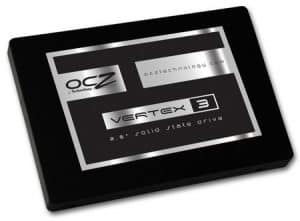 SSD (Solid State Drive) takes place when speed is really important. Solid State Drives provide unbelievable speed and data access time. Also, SSD is completely silent because it doesn’t have any moving parts. You can find Solid State Drives only on the best laptops, which cost a lot. The main disadvantage of Solid State Drives is it cost for 1 GB of storage space. That’s why you will not find many laptops with SSD that have large spaces on them. Usually, these laptops include a 128-256 GB SSD.
SSD has one very important feature which will be very helpful for people who need safer data storage. There are fewer chances for your SSD to be damaged by physical shock. As long as Solid State Drives don’t have moving parts, they can not be damaged by simply falling or being hit. Only very extensive damage can cause your data to be lost. Needless to say, Hard Disk Drives can be damaged easily if your laptop falls while it’s running. On the other hand, SSDs can’t be used for periods of time greater than 3-4 years because you can only rewrite data on them so many times.
I recommend Solid State Drives for people who need the fastest performance for their laptop, a very quiet machine and very safe data storage.
Battery
Today you can find laptops with 4, 6, 9 and even 12-cell batteries. Every cell is an actual battery, so the greater the number of cells, the longer you can work on your laptop without having to recharge it. 4-cell batteries are very rare. Usually, on even the smallest of laptops, you will find a 6-cell battery. If you use your laptop when you commute or while traveling – I highly recommend looking for laptops with 9-cell batteries which also have small screens(i.e. 13.3-inches) or you can also choose a 10.1-inch laptop with a 6-cell battery. Screen size matters a lot when we are talking about battery life because most of the energy that is used goes to lighting up your screen. If you have a smaller screen, you can work longer. For those who need a large screen and a long battery life, I recommend searching for 12-cell batteries which are usually sold separately.
Durability
Do your research and figure out if the laptop is durable. A lot of reviews are on the internet and it will be up to you to find them. Most of these reviews are very honest and so you should read about how durable the computer is.
Make sure that the laptop will last you a long time and even though you are looking for a laptop, this does not mean that you will need to sacrifice durability and overall quality.
Size And Weight
The one thing that a lot of people do not think about when they are looking for a laptop is the size of their laptop. This is important because it will change the way that they will travel with the laptop.
The bigger the laptop, the harder it is to travel with it because it will heavier and bulkier. A lot of people will admit that it can be tough to work with bigger laptops while others will want to have a big laptop. It really is important to look at the size and weight when looking for the best budget laptops out there.
If you are serious about being able to find a good laptop, then it is important that you think about these three features. These are small yet important features that will greatly make the search easier. As long as you keep searching, you will definitely be able to find the best laptops for overwatch out there.
Just because you are looking for good quality does not mean that you will need to spend a fortune. There are plenty of laptops that you can buy with great quality that is going to be very affordable.
Conclusion
They are so many laptops that one might pick for a specific job such as gaming the latest PC games, software programming, requires the laptop or computer to have good spices otherwise, it will not work,