
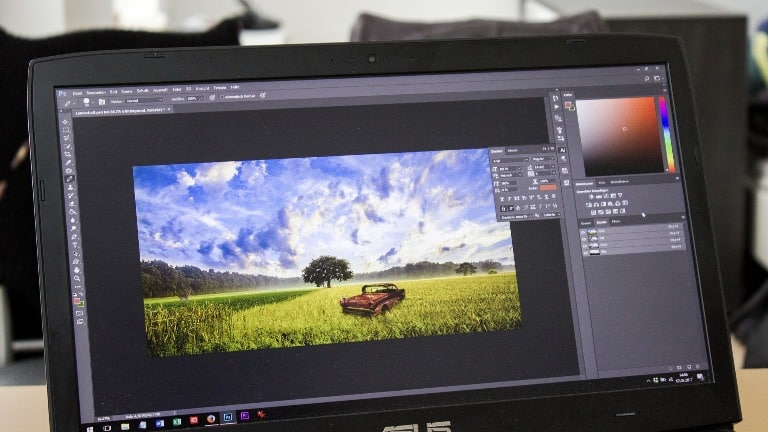
Adobe creative cloud had made screaming headlines in the most recent times. It is sometimes actually referred to as Adobe CC and it is a set of software application for windows computers and Mac OS and it is used by professionals to create designs and edit different kinds of footage.
Adobe creative cloud is a unique tool that enables you to be creative without any disturbances. This tool provides applications to work on a number of different projects from video editing, mobile designing to even desktop publishing.
These documents are saved in what is known as the cloud. But to run this tool one needs to have a suitable laptop for it.
And below is a set of 8 laptops that will sweep you off you’re your feet, you will love them without a doubt.
- Apple MacBook Pro
- Hp Envy
- Acer Nitro 5
- Asus ROG Strix Scar II
- Lenovo legion Y7000
- MSI GL63
- LG Gram 17
- Acer Predator Helios 300
Top 8 Best Laptops for Adobe Creative Cloud Reviewed for 2020
1. Apple MacBook Pro

 Firstly, it is one of the most popular brands on the market. It has a stunning retina display that produces good color reproduction and pretty viewing angles.
But it is expensive so you know before you totally fall in love with it. It has great build quality and this quality is by all means second to none. It weighs about 3lbs. and it is very light and is easy to travel with and it can even be carried without a laptop bag, its weight is bearable.
This laptop has the potency to smoothly run photoshoot as it has been equipped with Apple’s Mac OS software as in it is good and does great wonders.
It has a very good battery life of about 5 to 6 hours when there is moderate usage and if you doing lightweight activities you can get more battery life. It has an excellent 7th Gen intel core i5 processor that makes sure that your run all your adobe applications without any trouble whatsoever. And it equally has an integrated graphics that is powerful especially compared to a discrete.
But unfortunately, when it comes to its connectivity it’s somehow not a go area as it only has two USB Type C-ports that is one for charging and the other for display port.
Features:
Screen size 16 inches, storage is 512 GB SSD, RAM 16GB RAM, 7th Gen Intel Core i5 processor, Intel Iris Plus Graphics 640 Graphics card.
2. HP Envy

 It has a mediocre battery life; it can last for only 4 hours when one is doing moderate tasks but it is the best laptop for adobe creative cloud under the premium segment.
It also has a fingerprint scanner that is useful when you want to lock or unlock the device. This will prevent you from unlocking your laptop with a password every time.
This laptop will give you 512 GBPCle NV Me SSD storage and it is more than enough for all your needs. This processor enables you to perform all kinds of tasks without encountering any issues.
Features:
Intel Core i7 8565U, graphic card GeForce MX250, RAM 16GB, display resolution 1920×1080, display size 17-inch, RAM 12GB, hard disk 1TB, NVIDIA GeForce GTX 850 M.
3. Acer Nitro 5

 This laptop offers you amazing solid user-friendly software that makes sure you enjoy all your tasks without any trouble. It has an awesome graphics processor that has very immense size and gladly stores all your files with any problems.
It offers an incredibly fast and stress-free performance without lagging behind at any point. And with this it gives you endless freedom and you can download games and even play them online quickly and smoothly.
It goes on to have a dual fan cooling system that has been powered by Acer cool boost technology, these fans give you high fan speed and they also have a great cooling ability.
It also has a feature that helps you regulate cooling especially when you are having a heavy usage, because mostly when there is such an extra boost is needed.
Its RAM is very easy to access and in case you want to upgrade it in the future, that can be done to meet your preferences. It also has a spectacular cutting-edge design that is just beautiful and you cannot afford to stare away.
It is actually very budget-friendly and will entirely give you an incredible experience. It has a backlit that enables to work even at night without any troubles.
It also has an average battery life and it can last for about 3 to 4 hours when one is running photoshop or just any other adobe application. And if you are just using it for entertainment and other activities the battery lasts even longer.
It is a 15.6-inch full HD IPS display that has large bezels on all sides of the screen. It weighs 6lbs. and it is heavy I must say, it has decent build quality. It is finally good for adobe creative cloud because it has a 256GB M.2.SSD that performs tasks very fast unlike a traditional disk drive HDD.
Features:
Hard driver 256 GB, 8GB RAM DDR4, processor intel core i5 7300 HQ, processor speed 2.5 GHz, graphics NVIDIA GeForce GTX, screen size 15.6 inches.
4. Asus ROG Strix Scar II

It has a weight of 6lbs. meaning it is very heavy and if you are such a one that is looking for a lightweight laptop then this is not the best for you.
Other than being good for your adobe creative cloud it is also very efficient for high-end gaming.
Meanwhile, it has a lot of ports that will your connectivity very easy and flawless. It has a mini display port, Ethernet port and even an SD card reader to mention but a few.
You can multi-task and still do that efficiently on everything activity you may be doing as it has a good 16GB DDR4 RAM that is way more than what is required for an adobe application.
Its graphics card is super-swift it is a GTX 1060 6GB graphics card and it can run photoshop and you can even play modern games as affordable decent frame rates. It has a 17.3-inch IPS display and it does look gorgeous and attractive, it has good build quality and feels solid.
Features:
Hard drive 512GB, hard drive type, RAM 16GB DDR4, processor intel core i7 8750H Hexa core, graphics NVIDIA GeForce RTX 2060, screen size 17.3.
5. Lenovo Legion Y7000

This laptop will without a doubt help you render your projects with ease and its GPU will enable you to play games without any trouble. It has a backlit keyboard that is very useful and enables you to work even in the dark.
It weighs about 5.2lbs. it is heavy and is not necessarily the best laptop to buy especially if you do a lot of movements. By the way, its battery can last up to 5 hours but sometimes it is only 3 to 4 hours.
It is a 15.6-inch full IPS display that is very pretty and its build quality has not been compromised in any way.
It is a real solid build laptop and gives you the very best of hardware. It is good for multitasking and has been equipped with a 256GB PCle SSD and it has enough memory with a 16 GB DDR4 memory. It has very excellent performance and can never disappoint.
Features:
CPU 2.2GHz, display size 15.6, Graphics card NVIDIA GeForce GTX 1060 GPU, hard drive size 1 TB HDD + 128 GB PCIe SSD, native resolution 1920 x1080, RAM 16GB.
6. MSI GL63

This laptop has a battery life of about 2 to 3 hours and it is certainly not good enough, it could honestly get better. It has been built with a decent selection of connectivity ports. These ports include an ethernet jack,1mini display port and an HDMI among others.
It has a great processor with ultimate speed for your effectiveness in everything you do. It’s graphics card is very good and you can render any of your 3D projects even run heavy games and demanding games smoothly.
It has a storage od 512 GB NV Me SSD it is very sufficient for you to store any amount of data or files. But in case you needed more storage you can gladly add some on the inch bay that is being offered by this machine.
It also gives you a 16GB DDR4 RAM that is good enough to run multiple applications all at once instantaneously.
It is very affordable and is suitable for your adobe creative cloud, it has been created with a full HD display, it weighs only about 4.8 lbs. which is portable I would say.
You can either carry it in a bag pack or on your hands, whichever works well for you but my point is it is portable.
Features:
CPU 2.2 GHz Intel Core i7 8750 6, 32GB memory capacity, NVIDIA GeForce GTX 1050 4GB GDDR5 VRAM, screen size 15.6, resolution 1920 x 1080, hard disk storage 1×1 TB 2.5 SATA (5400 rpm).
7. LG Gram 17

It has been equipped with a massive 17-inch display and has an excellent battery life of 8 hours, this is good and it can’t disappoint you, it is exactly 8 hours nothing less unlike what happens with other brands where you find it says 8 hours yet it’s less, this one has been trued and people can testify.
It is thinner bigger and is a lightweight and all these properties make it portable and carrying it around is easy, it only weighs 2.9 lbs. And its display is longer unlike traditional laptops. It is quite a beast. It has a white backlit and comes with a fingerprint scanner that is placed at its power button.
It has an interesting and good port selection it has 2USB 3.1, Headphone jack and a micro card reader among other ports.
Features:
Screen size 17inches, storage 512 GB SSD, RAM 16GB DDR4 RAM processor intel core i7 8565U, graphics intel HD graphics 610.
8. Acer Predator Helios 300

Acer Predator Helios 300 has an audio system is good enough and has been built with a Dolby audio that is accompanied by two inbuilt stereo speakers. It produces very good sound with any distractions.
It’s display features a complete HD resolution that will give you ultra-smooth frame rates. It only weighs 2.5 Kg and it is portable enough, it has a 16GB RAM and game loading is fast.
This buddy will help you unleash the power and creativity. It has been built with an 8th Gen intel core i7 processor that is very powerful and efficient. It also has an NVIDIA GeForce 1060 graphics card that gives you a very vibrant and crisp gaming experience that is second to none
It is furnished with a memory of 256 GB flash memory that is a solid-state hard drive and it has been clothed with Windows 10 OS. Moreover, It also has an iron-red keyboard that is not only elegant but it makes sure that you hit the right notes and at the right time with no trouble at all.
It will keep you entertained for 7 hours with just one charge and it has a USB 3.1 (Type-C) that allows you to charge your laptop very fast and with ease. Apparently, it also has a dual all-metal aero blade 3D cooling system that makes sure the temperature of the system is okay.
Features:
Discreet graphic processor, NVIDIA GeForce, GTX 1060, screen size 15.6,16GB RAM DDR4, processor intel core i7, hard drive capacity is 256 GB, memory speed 2666 MHz.
Things To Consider When Getting The Best Laptop for Adobe Creative Cloud.
Operating System
This is what determines how the interface looks and how it works and the software you can use, there are various software’s and adobe creative cloud can be tried out on these system’s such as Windows 10, Mac OS, Windows 7 and 8, or even Chrome OS and the browsers required are google chrome, safari, Microsoft Edge of even firefox so please make sure that you get a laptop that can access these things.
Language Availability
Make sure the laptop you are getting is not only limited to one language, it should be diverse
Processor
This is like a brain of a laptop, it enables you to move your mouse, open a program or even load different files. Intel or AMD processor’s that have 64-bit support, 2 GHz or any faster processor can be used.
RAM
This is Random access memory this is in charge of how many things you can store 2GB or even more RAM can be used and 8GB can work well.
Good luck as you make your choice.