
Are you looking for fine binoculars to work with? If you are then you have to the right place as I will gladly help you out. Their lots of popular models out there but I will review the top eight best Image Stabilized Binoculars I know will certainly work best for you. However, before we to that part, let us first have a look at what really image-stabilized binoculars and how they actually work. This would help give insight about what we are talking about and more information to you if it happened that you hardly know what image-stabilized binoculars are. An imaged stabilized binoculars is a binoculars in which one attains image stabilization using an optical solution, electronic, sometimes, even a combination of both to remove the shakiness of your hands. In the digital world, this technology has long been part of the functions of both camcorders and digital cameras. Now, this technology is being used in the function of binoculars to produce stabilized images.
Binoculars designed by Canon call this image stabilization technology “Vari-Angle Prism” which is composed of two pieces of flat glass joined by a flexible bellow made of a special film that can expand as well as a contract when required. Between the two glass plates is a space filled with a high refractive index fluid, usually silicon-based oil, and it is specially developed by Canon. The mechanism in the binoculars is one in which one glass rotates for pitch movement whilst the other for the yaw movement. This, therefore, implies that there is a variation of the top angle due to the expansion and contraction of the flexible bellows. For movement detection, there are two sensors within the binoculars that detect horizontal and vertical shaking respectively. What you will expect in a stabilized binoculars is a Doublet Field Flattener, Image Stabilizer, Super Spectra coating as well as a Lead-Free Glass. Other prisms found in other brands include roof prism and Porro prisms.
Image-Stabilized binoculars are ideal for high magnification as it produces clearer pictures under high magnification such as x15 which would be otherwise impossible to keep the image stable and also avoid it blurring. This type of binoculars is thus a little more sophisticated than the regular binoculars mostly used for hiking. The image-stabilized binoculars are suitable for hobbies such as astronomy, bird-watching, hunting, boating and anything of that sort that you would need the binoculars for. So, before you spend on one, your daily activities are what need to be taken into consideration. Other basic things to know before buying image-stabilized binoculars include things like brand, model, design, price tag, size, weight, color, etc.
Now, let us have a look at the top eight stabilized binoculars trending on the market.
1. Canon 12×36 IS II Binoculars

 Now get rid of image-shake forever with Canon 12×36 IS II Image Stabilized Binoculars (model #9332A002). These 12×36 binoculars from Canon are light-weight, compact and produce distortion-free images. Moreover, they have amazing power.
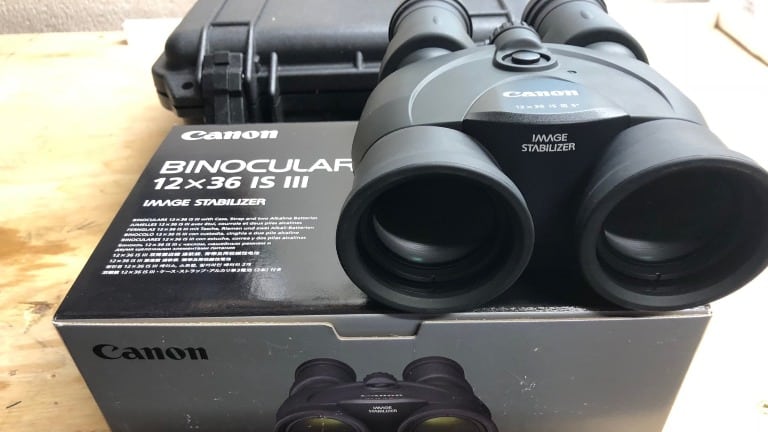
Second, on the list is Canon 12 x 36 Image Stabilization III Binoculars which is one of the best image stabilized binoculars out there comprising of 12x magnification capability. It is specially designed to offer comfort and for having a rubber coating on the housing ensuring a firmer grip when handling it. The binoculars are user-friendly as it offers you no trouble at all in using it especially for the stabilization button being located in the middle. It is very enjoyable binoculars to use and its Canon precision optics is ideal for use as it ensures that there is a production of high-resolution images. Another great feature about the Canon 12 x 36 Image Stabilization III Binoculars is the Super Spectra coating it has which ensures that stray light, as well as unwanted reflections, are completely prevented. The binoculars are readily affordable and are of lightweight design so if you wanted to carry it around you would have no problems at all. Also, it being a Canon product you are sure to be satisfied with the binoculars and its durability thus this is a great pick for you. If you are a Canon fan and this binoculars appeals most to you, feel free to get your hands on it!
Main Features
- Powerful Magnification up to 12x
- Unique technology- Image Stabilizer for stable view
- Lightweight and portable
- Contains 14.5mm eye-relief
- Doublet field-flattener for producing beautiful, flat and even images
- The battery life of almost 4 hrs of continuous operation•
- Curved surfaces for better grip
- Glasses are only lead-free
- Canon model #9332A002
If powerful magnification using a pint-sized pair of IS binoculars is your need, then Canon 12×36 II image stabilizer binoculars should be your choice. For using these mean little binoculars, you won’t even be required to carry around a tripod with you, as these come with Canon’s awesome image stabilizing technology. If you are an avid gazer, you would know that higher the magnification, the steadier your hands need to be. With this binoculars’ 12x magnification, you would not have to worry about unsteady hands as the microcomputer inside the binoculars will ensure you see a steady image, the vibrations notwithstanding.
The intensity and clarity of the images produced by these binoculars is truly outstanding. With the help of Doublet field-flattener lenses, the images produced are crisp, flat and distortion-free. Also, the apparent field of vision is more than acceptable 60 degrees, meaning you won’t need to turn your head to follow each of the little movements of the object. The stabilization is also remarkable. The inbuilt microcomputer is so fast that within two-hundredths of a second, it prompts the apparatus to counteract the slightest of vibrations. So even if you are riding in a car, you will get a steady, sharp and clear image with a lot of magnification.
These binoculars have been cleverly designed to make them inconspicuous when in use for watching wildlife. The exterior is low reflectance and the front is low gloss. The Image Stabilization button is placed at the top and center making it easily accessible by both the hands. The focusing is large and also located at an accessible place making the focusing smooth. The eyepieces have large eye-cups that make for comfortable viewing. The long 14.5 mm eye-relief is ideal for those who wear eyeglasses. The binoculars are rugged and the rubber cover over the whole of the lens assembly provides impact resistance.
One of the most important features of these binoculars is that only lead-free glass has been used in making the lenses. The Super Spectra lens coating over the lenses does a fine job of eliminating internal reflection and deliver images that are vivid, clear and with accurate color balance. The battery life is also quite decent with four hours of continuous operation possible. The binocular surface is curved and contoured to make it easy to hold. Canon has been in precision optics for 70 years, these binoculars are a testimonial for their experience and expertise. So, why wait to buy one today for yourself.
2.Canon 10×30 Image Stabilized Binoculars

 This Canon 10×30 Image Stabilized Binocular (IS) is based on its unique image stabilization technology, which reduces image shaking. In my opinion, it is one of the best consumer-rated binoculars which you can find in the market today.
Main Features
- Can be best used for sporting events or viewing from an unsteady/moving platform
- Good for watching objects for a long period of time
- Canon’s super spectra multi-coating for superior contrast
- Provides grip, it has a water-resistant rubber coating
- Battery backup of almost 20 hours
Whether it is bird watching or watching distant wonders using binoculars, one thing that takes away from a rich and enjoyable experience is the shaking of the image due to the instability of the hands. The more the magnification, the more these shakes are pronounced. Of course, binocular stands are available to solve this very problem, but it is not always practicable to carry a tripod stand with you. For this reason, image stabilizing binoculars have become quite popular. The Canon 10×30 IS binocular is a fantastic image stabilizing binocular.
The Canon 10×30 binoculars feature digital shake suppression technology. This helps in making the image appear steady to the eye even when your hands are shaking. The stabilizer works with the help of horizontal and vertical gyroscopes to detect motion in all directions. The motion, arising from shaking, is calculated instantly by a microcomputer and the movement is counteracted optimally either by a set of vari-angle prisms or a tilt mechanism. This effectively produces an image as if there were no vibrations.
What is more is that these binoculars are very lightweight, weighing 22 ounces, so carrying them around is very easy. They have been designed keeping in mind ergonomics. The binoculars are nicely contoured to fit in your hands perfectly and are perfect for spending a long time gazing. The focus is mounted at the center and the image stabilization controls are easily accessible by either hand. Your hands will not pain even after a particularly long session of gazing.
The binoculars come complete with a neck strap and a case. The image stabilization works just fine in a vertical position, as in for stargazing, and horizontal positions. The binoculars are very efficient in their battery usage, with AA batteries lasting typically up to 20 hours; the amount of battery usage can vary depending on various factors though.
The Canon 10×30 IS image stabilizing binoculars (2897A002), owing to these great features, have become quite popular. The clarity, magnification is typical Canon. The image stabilization works very well even if you have very shaky hands. If you are going sea-faring, make sure you take a pair of these with you as the images produced by these will be very stable even if the sea is particularly choppy.
Canon has always been known for its high-quality optics and combined with this stabilization technology, gazing at a distance has become a joy to the eye. You can buy Canon 10×30 IS and even save money for your favorite events.
3. Canon 18×50 IS Binoculars

 You can now experience amazing image clarity with the new Canon 18×50 IS image-stabilized all-weather binoculars.
Not only do these binoculars give outstanding picture clarity, but they also ensure shake-free viewing with their image stabilizers.
I cover everything you need to know about them below.
Main Features
- Internally fog proof
- Waterproof and dustproof
- Image stabilizing
- High power 18x magnification
- Perfect picture clarity and no color fringing due to multi-coated lenses
- UV protection on the lenses
These new Canon 18×50 IS image-stabilized all-weather binoculars (4624A002) are an excellent addition to Canon’s range of binoculars. They are equipped with image stabilizers to give you the perfect shake-free viewing experience. Needless to say, like all other Canon binoculars, its optical features are magnificent. The wide 50 mm objective lens gives amazing contrast and picture clarity.
These binoculars are highly durable in all kinds of weather conditions; they’re waterproof, dustproof and shock-resistant, making them recommendable for all kinds of adventure trips.
These binoculars are also known to give ultra-bright images even in dim light situations. The super spectra coating present on the lenses does not reflect too much light; as a result, it makes the image brighter.
Compared to other binoculars in the same range, the Canon 18×50 is lighter and more compact, making it more field worthy. Also, it has a strong construction with a very high magnification power. These features, along with its image stabilizers make it an ideal option for bird watching, hunting or event viewing.
Most users seem to have a common complaint that the lens cap should be attached to the binoculars since this way they don’t tend to get lost. Other binoculars in the same range, such as the Zeiss are far better in terms of optical image quality, however, the image stabilization is found to be better in the Canon.
Generally, customer reviews show that most users are happy after buying the Canon 18 x 50. While buying the same, ensure that you buy a neck strap for it since it isn’t pre-installed. You can easily buy them from many online stores at an approximate price of $1100 only. Do your research thoroughly before purchasing them because some websites offer attractive discounts.
4. Canon 15×50 Image Stabilization Binoculars

 The Canon 15 x 50 IS image-stabilized all-weather binoculars are sure to give you a breathtaking view like never before. Their image stabilization technology provides a perfect shake-free viewing experience.
Main Features
- Very high magnification
- Image stabilization
- Wide, extra bright 50mm objective lens.
- Powerful 15x zoom.
- Ultra-low dispersion elements.
- Waterproof, dustproof, and shock-resistant.
The new Canon 15 x 50 is an outstanding version of Canon binoculars. It brings together all the important features required in a binocular for all kinds of viewing. It has remarkable optics, that give brilliant clarity, sharpness, contrast, and brightness, making every view a memorable one.
The binoculars have strong construction, making them more durable for field trips. They’re also waterproof, dustproof and shock-resistant, thus making them ideal for all kinds of requirements like bird watching, astronomy, sea viewing, hunting and nature photography.
The 50 mm objective lens gives extra bright images in all kinds of light situations. The high magnification can be a problem while handheld viewing because minor muscles twitch can give a very big difference in the view. So the image stabilizer is an additional feature that is highly useful. The image stabilizer helps in steadying the view during handheld viewing.
Earlier on, the usual complaint by users was that the finger that holds down the image stabilizing button becomes numb after excessive use. However, the new design includes a button that you need to press once to enable the image stabilizing feature, and then press once to disable it. In case you forget to switch it off; it has an automatic switch-off within 5 minutes. This is another aspect that makes the Canon 15 x 50 more convenient than other binoculars of its range.
Ongoing through most customer reviews on various websites, it seems that the Canon 15 x 50 Image Stabilization binoculars are a good buy with very few drawbacks if any. So go ahead and get a Canon 15 x 50 to enhance your viewing experience and take it to a whole new level.
5. Fujinon Techno Stabi TS1440-14×40 IS Binocular
 On number six we have the Fujinon Techno 14 x 40 Image Stabilized Binoculars which is top-quality binoculars from Fujinon. We all know that Canon is one of the leading brands out there besides Nikon but there are lots of other good brands like Fujinon which aren’t so far behind. The binocular is capable of offering stabilization of a magnification of 14x which is ideal for use if you wanted higher magnification. When used in simpler conditions it gives out expansive, consistent pictures with ease as compared as you go higher in magnification which tends to offer a bit of trouble being a slightly bigger binocular. It has an enormous 5 degree of stabilization feature which thus makes it most definitely ideal for use in difficult situations such as tracking an object in motion whilst on a boat cruise or perhaps on a plane. The binocular is thus a great pick as it offers clear and crisp image production, has superb image stabilization and its long-lasting battery makes it a great deal. What makes it another great pick is the strap which is another great thing for you! However, this binocular is more expensive than the Canon one so it would depend on your budget. If you are okay with it, then you can go for it.
Main Features
- 14X magnification
- Equipped with ±5° of vertical stabilization
- Works with any 4 × AA type alkaline batteries
- Fogproof
- Waterproof
- Image stabilizers.
The Fujinon Techno 14 x 40 Binoculars are by far the finest 14x binocular in terms of image quality, image stabilization, and the overall viewing experience. The optics used in the binoculars is exceptionally good. They produce perfect images with the right amount of brightness, sharpness, contrast, and clarity.
The Fujinon Techno 14 x 40 is perfect for the ideal viewing experience while in a car or in a boat. This makes the binoculars more preferable as compared to the other low magnification binoculars. The image stabilization technology is very effective, it compensates for almost 3 degrees of movement. The image stabilization comes in two different steps in the Fujinon Techno 14 x 40. The first is the normal mode, which helps in minimizing major movements like when you’re in a boat or a car. On the other hand, the second is the fine mode which helps in reducing minor movements such as small hand movements that get maximized while using the magnification power.
This aspect makes it an absolute must-buy for birdwatchers, wildlife viewing and for other viewing purposes that require low magnification, good image stability, and high picture quality. Among other features, it has a wide objective lens that helps in making the images brighter and clearer. It also has a very light and compact design, making it all the more field worthy.
All in all, the most attractive feature in the Fujinon Techno 14 x 40 is its image stabilization. To add to this, it gives better image quality than most other small magnification binoculars. This makes it one of the best options in its range. So go ahead and buy the Fujinon Techno 14 x 40 if you’re looking for fine image quality and outstanding image stabilization along with a relatively small magnification power.
Factors To Consider When Buying The Best Image Stabilized Binoculars
Binoculars come with a wide range of features. Each uses lenses and prisms in slightly different ways, and choosing carefully can mean the difference between an excellent experience and a blurry image.
Magnification and Objective Lens Diameter:
These are always described together using a pair of numbers such as “7×50”. When described this way, the first number refers to the magnification amount, and the second to the diameter of the objective lens. For example, “7×50” means that images are magnified 7x, and the objective lenses have a diameter of 50mm. These measurements are of the greatest importance to image quality so they need to be considered carefully.

Higher magnification will allow you to see objects further away but will narrow your field of view. So you’ll see further, but for objects close to you, you’ll be restricted to looking at a smaller area and refocusing if that object is moving. A lower magnification from about 7x to 10x is fine most of the time, whereas magnifications of 20x to 30x are necessary for astronomy.
Larger lens diameter allows more light to enter the binoculars and reach your eye. While they increase weight significantly, bigger lenses are best for night-time viewing, hunting at dusk or dawn when game move, and even low-light environments such as heavily wooded forests.
Field of View (FOV):
Refers to the area visible to you as you use your binoculars. The number given tells you how big an area you can see when viewing objects 1000 yards away. For example, a FOV of 372 ft. means you will see an area of 372 ft. 1000 yards away from you. Wide-angle lenses are available to increase that FOV for game hunters and sports fanatics.
Eye Relief:
This is the minimum distance at which you must hold the eyepieces away from you. This is important especially for those who wear eyeglasses, so make sure to test this in-store to find a set of binoculars that are comfortable for you to hold to your eyes.
Exit Pupil:
It is the virtual opening at the center of each lens through which light can move on its journey through the binoculars. Optimally this exit pupil needs to closely match your own pupil, as the light that travels outside yours is lost. Therefore this becomes important when you use binoculars at night – your pupils dilate to take in more light, so a bigger exit pupil of about 7mm is ideal for astronomy. However, during the day your pupil will be about 2.5mm.
Calculate the exit pupil by dividing lens diameter by magnification – so binoculars at 7×50 have a lens pupil of about 7mm and are good at night. Binoculars at 20×50 not only offer more magnification but a smaller exit pupil of 2.5mm which is ideal for bright daylight use.
What are coated lenses?
Anti-reflective coatings can make a huge difference in image quality by preserving light as it moves through the binoculars and to your eyes. Magnesium fluoride is most commonly used for either prism type, and binoculars may be listed anywhere from coated (at least one surface is coated with anti-reflective material) through multi-coated (two or more surfaces are coated) and on to fully multi-coated.
Other coatings such as phase coating, aluminum coating, silver coating, and dielectric coating are required for Roof prism binoculars.
Thanks for reading our guide for the best Image stabilized binoculars, I hope our guide has highlighted all that is required in order to choose good binoculars.